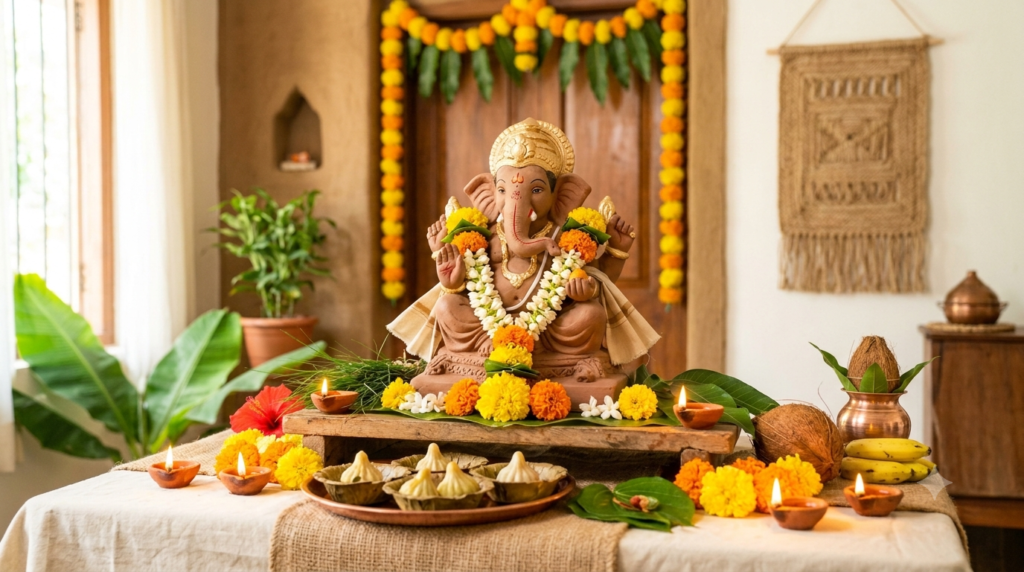
Ganeshotsav (Ganesh Festival) has been celebrated with great enthusiasm and devotion for generations, especially in Maharashtra and in several other parts of India. During this festival, homes, streets and public spaces come alive with beautifully decorated Ganpati idols, music, lights, prayers and celebrations. For many people, welcoming Bappa is not just a religious tradition, but an emotion deeply connected with faith, family and memories. As we continue to celebrate this beloved festival, the idea of an eco-friendly Ganesh Chaturthi (Ganeshotsav) gives us an opportunity to celebrate our traditions while also being mindful of the environment.
Why Is an Eco-Friendly Ganeshotsav Important?
The beauty of festivals like Ganeshotsav lies in bringing people together. In the middle of our busy lives, they give us a reason to meet, sit together, talk, laugh and share special moments with our loved ones. They remind us that life is not only about our individual journeys; it is also about being there for one another, understanding each other and sharing both the good and difficult moments of life.
If a festival is meant to make our lives better, should the way we celebrate it harm the world we all live in?
Every year, when Ganeshotsav celebrations come to an end, we also see another side of the festivities. Waste may be left behind, decorations are often thrown away, and water bodies can be affected by the immersion of idols and other materials. Seeing pollution after a festival celebrated with so much faith and devotion can be deeply concerning.
We have faith in Bappa, but should our celebrations come at the cost of nature and other living beings?
I believe they don’t have to.
Our faith, traditions and concern for nature can exist together. Small and thoughtful choices, such as choosing eco-friendly idols, using sustainable decorations, reducing plastic use, being mindful of fireworks and celebrating Ganesh idol immersion responsibly, can make a difference. This way, we can keep the faith, joy and traditions of Ganeshotsav alive while celebrating in a way that respects nature.
So, how can we make these small changes in the way we celebrate Ganeshotsav? Let us look at them one by one.
Which Ganesh Idol Is Best for an Eco-Friendly Celebration?
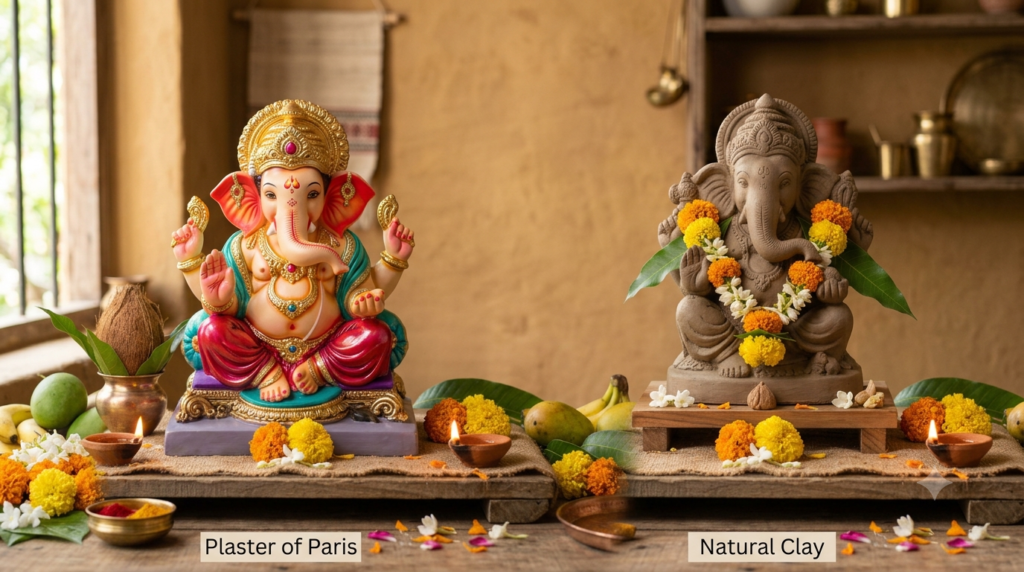
When we bring Bappa home, choosing the right idol is one of the first steps towards an eco-friendly Ganesh Chaturthi (Ganeshotsav). Traditionally, idols were often made from natural clay, but today many are made from Plaster of Paris and painted with colours that may not be eco-friendly. The materials used to make and paint the idol can have an impact on the environment, especially after immersion.
When such idols are immersed in water, the materials may not break down easily and can add to pollution in rivers, lakes and other water bodies. Some paints and other materials may release harmful substances into the water. This can harm water animals and make the water less safe for humans and other living beings.
Choosing an idol made from natural clay and painted with eco-friendly colours can help reduce this impact. The CPCB guidelines state: “Idols made up of only natural, bio-degradable, eco-friendly raw materials without any toxic, inorganic raw materials shall be banned.”
Whether we make the idol at home or buy it from the market, both are good options. What matters is that the materials used are eco-friendly.
It may seem like a small choice, but it allows us to welcome Bappa with the same love, faith and devotion while also showing care for nature and other living beings.
How Can We Make Ganeshotsav Decorations Eco-Friendly?
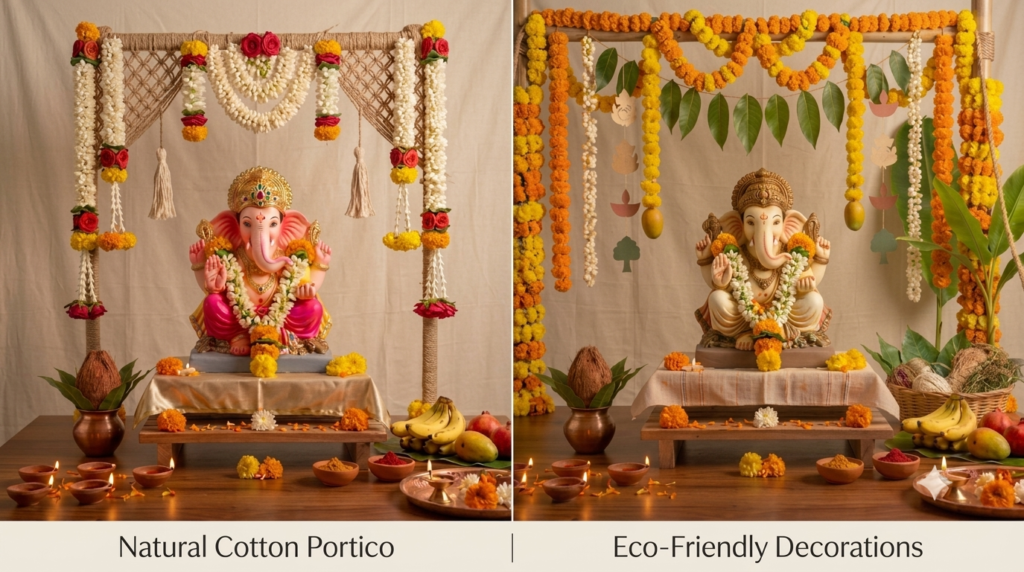
A festival does not need a lot of plastic or expensive decorations to look beautiful. Simple, natural and reusable materials can create a warm festive space around Bappa.
Flowers, leaves, bamboo, jute, cloth, paper and reusable decorations can help reduce the use of plastic and disposable materials. We can also reuse decorations from previous years instead of buying new ones every time. Simple handmade decorations can make the celebration feel personal while reducing unnecessary waste.
We often think that a grand celebration needs more decorations, but sometimes, simplicity can be just as beautiful. Decorating Bappa with care does not mean making the celebration less colourful or joyful. It simply means being more conscious about what we use, what we reuse and what we throw away.
Can We Reduce Plastic During Ganeshotsav?
Celebrating an eco-friendly Chaturthi (Ganeshotsav) does not require us to completely change the way we celebrate. A few thoughtful choices can make a meaningful difference.
Ganeshotsav is celebrated not only at home but also through community celebrations. Whether in villages or cities, these celebrations often involve large gatherings, decorations and other arrangements that can also create more waste.
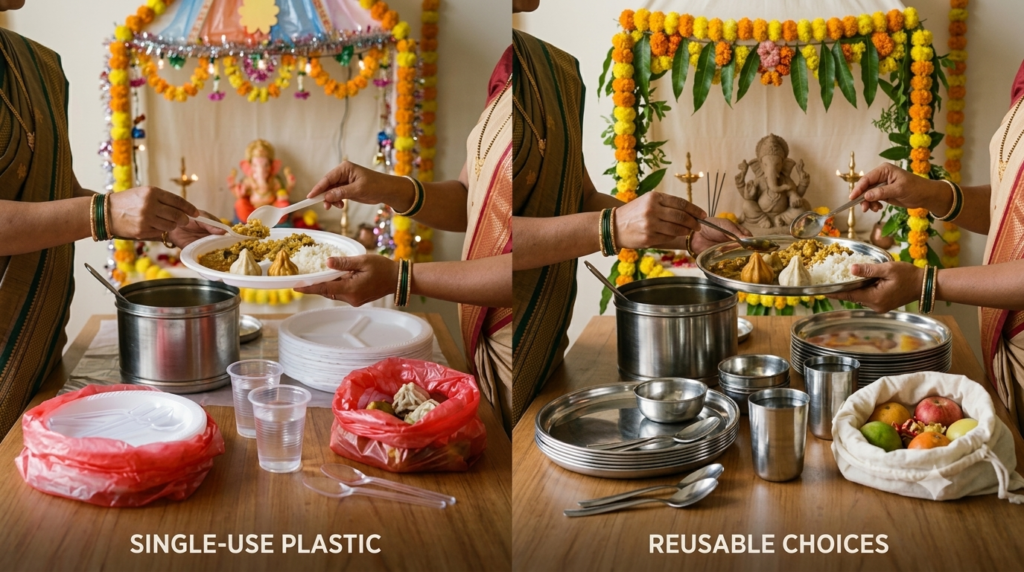
One simple way to reduce this waste is to be more mindful of our use of plastic. During festivals, we may use plastic cups, plates, spoons, bags and other disposable items to distribute prasad (food) without thinking much about what happens to them afterwards.
Instead, we can choose reusable plates and glasses, carry cloth bags and avoid unnecessary single-use plastic. We do not have to eliminate every form of plastic overnight. Being more aware of what we buy, use and throw away can itself be an important step.
Can We Celebrate Ganeshotsav Without Fireworks?
For many people, Ganeshotsav is incomplete without the sound and sparkle of fireworks. The excitement of watching colourful fireworks in the sky and hearing the festive sounds has become part of the celebrations. But have we ever stopped to think about what these moments of celebration leave behind?
Today, we have many varieties of fireworks to choose from, including sparklers, rockets, crackers, bombs, fountains and ground spinners. While they add excitement to the celebrations, they can also affect the environment, people and animals around us.
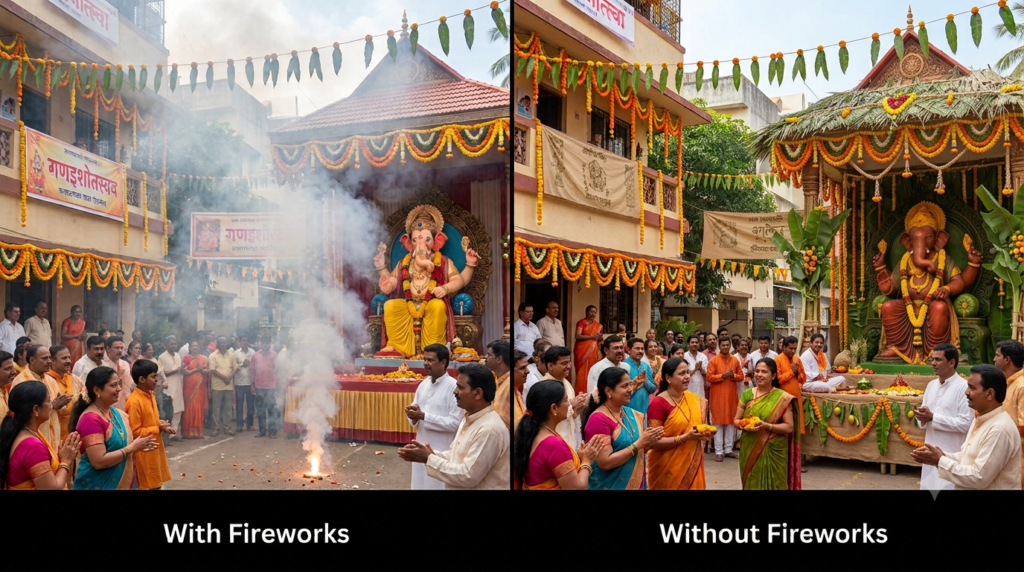
Fireworks can contribute to air pollution. The smoke and fine particles released by them can remain in the air for some time, affecting air quality. This may be especially concerning for people with respiratory problems.
The loud sounds are another concern. Fireworks can create noise pollution, and very loud sounds can be uncomfortable and disturbing for young children, elderly people, patients and animals. In addition, during Ganeshotsav processions, loud DJ music can also contribute significantly to noise pollution. What feels like a few moments of fun for us can be frightening or stressful for others.
This does not mean that we must take away the joy and excitement from Ganeshotsav. We can simply be more mindful about when, where and how we use fireworks. Reducing unnecessary fireworks, especially very loud ones, can help us enjoy the festival while being more considerate towards nature and other living beings.
How Can Ganesh Idol Immersion Be Made Eco-Friendly?
The farewell to Bappa is an emotional moment for devotees. After days of prayers, celebrations and togetherness, Ganesh idol immersion marks the end of the festival. It is also a time to think about how we can say goodbye to Bappa without leaving pollution behind.
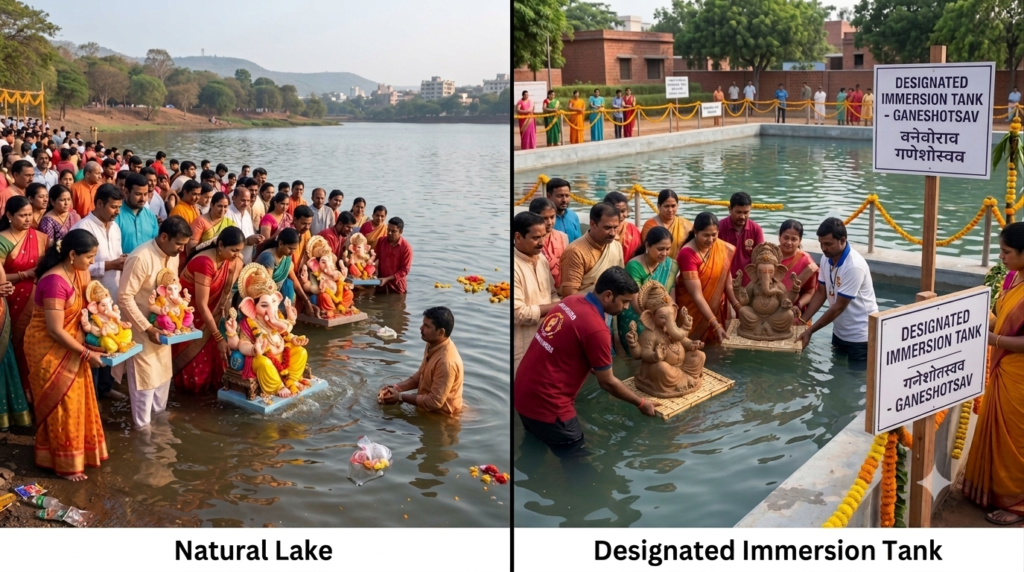
One simple step is to choose designated community immersion tanks or home immersion where permitted, instead of immersing idols directly in rivers, lakes or other natural water bodies. Local guidelines should always be followed, as immersion arrangements can differ from one place to another. The CPCB guidelines also state: “As far as possible, immersion of small idols should be done at their homes in eco-friendly manner i.e., in a bucket filled with water” (11). For community immersion, the guidelines recommend a “temporary artificial tank or pond” (10).
During immersion, flowers, garlands, decorations and other festival materials may also end up in water bodies. We can collect these separately and dispose of them responsibly instead of throwing them into rivers, lakes or other water bodies.
The way we bid farewell to Bappa can reflect the same love, faith and devotion with which we welcomed him. A little care during this final step can help protect water bodies and living beings around us, allowing us to leave behind memories, devotion and gratitude rather than waste and pollution.
How Can We Teach Children to Celebrate Responsibly?
Festivals are not only about celebrating traditions; they are also about passing those traditions on to the next generation. The way we celebrate today can shape how our children celebrate in the future.
Children naturally enjoy the colourful decorations, music, sweets and excitement that come with festivals. Ganeshotsav gives us a wonderful opportunity to teach them how small choices can help us care for nature while celebrating.
Education plays an important role here. We can help children understand which things are good for the environment and which can harm it. Instead of simply telling them what not to use, we can explain why certain choices are better and let them be part of making those choices.
They can make paper or cloth decorations, create simple flower arrangements, reuse decorations from previous years and help sort festival waste. Even making a small eco-friendly Ganesh idol together can turn into a fun learning experience.
When children learn through these simple experiences, environmental responsibility becomes something they see, practice and understand, rather than just something they hear about. These small lessons can stay with them and become part of the way they celebrate festivals as they grow.
After all, the way we celebrate today can become the tradition our children carry forward tomorrow.
Let Bappa’s Celebration Be a Celebration of Nature Too
We do not need to transform everything overnight. Small, thoughtful choices can be the beginning of a more responsible Ganeshotsav.
Choosing a natural clay idol, reducing unnecessary plastic, reusing decorations, limiting fireworks and following responsible immersion practices may seem like small steps. But when many of us make these choices, their collective impact can become meaningful.
We already have guidelines and laws related to eco-friendly idols, decorations, solid waste and idol immersion. However, simply having laws and guidelines is not enough. Proper implementation and enforcement are equally important. When these rules are not properly enforced, people may not pay enough attention to them.
An eco-friendly Chaturthi (Ganeshotsav) does not ask us to celebrate less. It simply reminds us to celebrate thoughtfully and be a little more mindful of the choices we make.
We can start with just one small change this Ganeshotsav. When many of us take that step together, we can create a bigger change.
And perhaps the most beautiful way to welcome Bappa is to leave a little more kindness behind when the celebrations are over—not only in our hearts, but also in the world around us.
Reference:
- Central Pollution Control Board. Revised Guidelines for Idol Immersion. Ministry of Environment, Forests and Climate Change, Government of India, 2020. CPCB. Accessed 15 Sept. 2026.
Related Articles
If you enjoyed this article, you may also like:
The Dowry System in India: A Practice That Still Haunts Women
Victim Blaming in Rape Cases: Why Rape Is About Mindset, Not Clothes or Lifestyle
Ganpati Bappa Moraya….!!!
Excellent and thought-provoking article! 👏 Your words reflect wisdom, social responsibility, and concern for our environment. Keep inspiring people through your writing and continue your wonderful work for society, spiritual values, and nature. 🌿🙏
Keep writing, keep inspiring, and keep making a positive difference!
Thank you so much for your kind and encouraging words.🙏 I’m truly glad that the article resonated with you. May our celebrations continue to bring devotion, happiness, and greater care for nature. 🌱🙏
Keep supporting and inspiring! ❤️
खूपच सुंदर लिहिले आहे…
खूप खूप धन्यवाद! ❤️ तुमच्या कौतुकाच्या शब्दांनी आणखी सुंदर लिहिण्याची प्रेरणा मिळते. 🙏🌿
Your writing style is unique and captivating..👌
Thank you so much! ❤️ So glad my writing connected with you. Your words are truly encouraging! 🙏✨